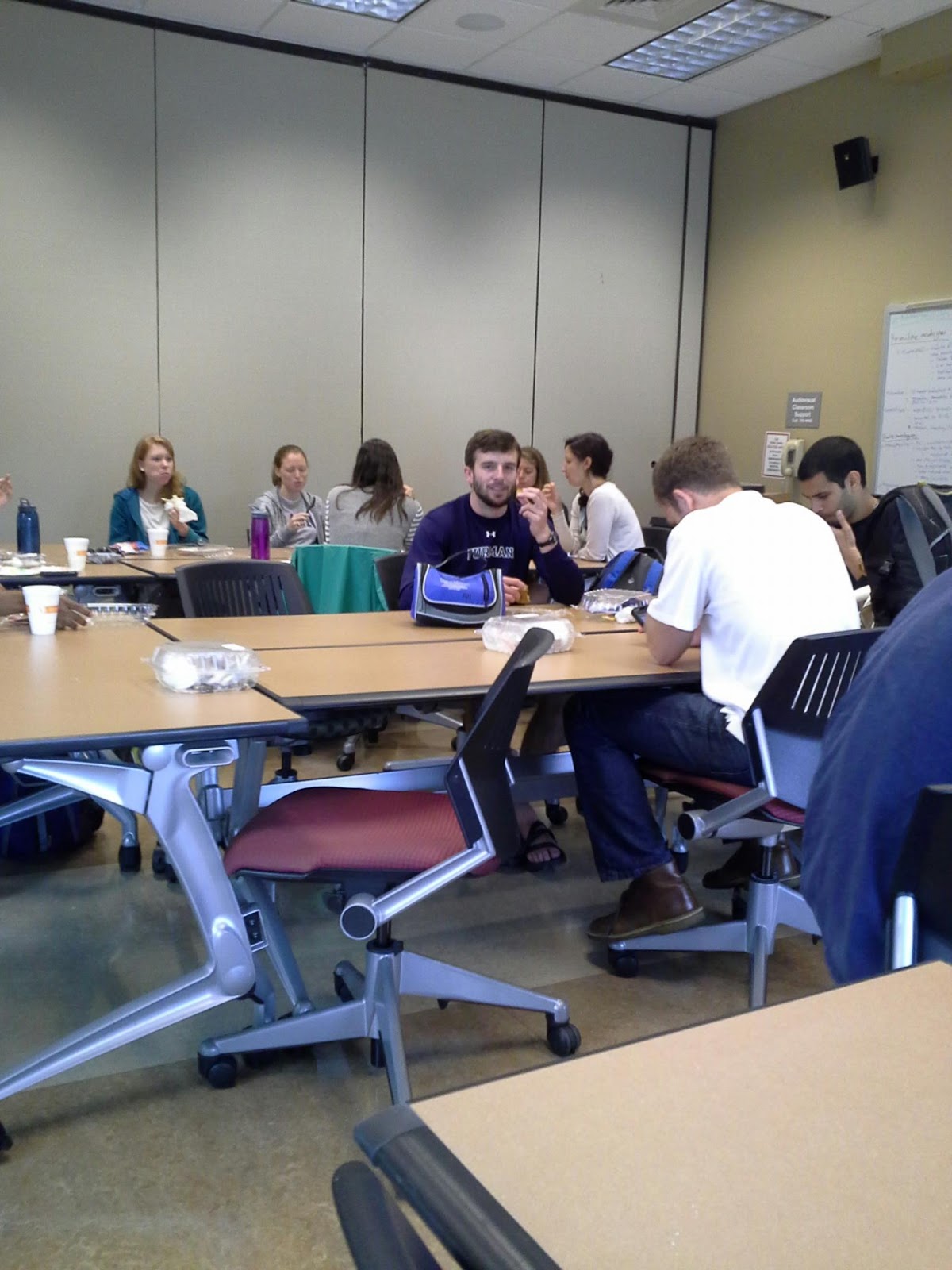
Ken asks the audience: commentary on - what is a date?

Last week's question was: what counts as a date?

Here's
 some commentary from Christian Baker and Trevor Henry:


CB: I'll send you what Rose and I think. We're working on this as the two of us...which brings me to point 1. In order for it to count as a date it must be just the two of us. (exception to the rule: double dates). One party pays. As a southern gentleman I'm inclined to say the male pays for the date...but as a starving medical student with a working fiancee, she will take over that role for a little bit. That doesn't mean we wont be going on any dates until I make a paycheck though. Thanks Rose! Moving along. I think for it to be a full blown official date it must be something special. It has to make the girl feel special like you went out of your way to do something nice. You've got to be intentional about it. That's Rose and my two cents worth.


TH: What is a date? The meaning of the word “date” depends on who you ask. Some of my friends consider the night they meet someone at the bar, share some laughs, and spend the night together as a first date. Some of them consider a date to be a personal encounter of 2 mutually romantically interested people, which begins with a formal invitation including explicit romantic intent. Some say a date is simply an intimate interaction between two people, a shared experience by two people in communication. Some see a date as a catch-up between people, whether the catch-up-ers are romantic or platonic. How many times have you heard “It’s a date!” as a confirmation to planning a get-together with an old friend?


I wrote a segment of this blurb on a plane last Sunday, sitting across the aisle from a talkative, particularly loud sophomore in college and her newfound friend, a businessman with a family. By the time we landed, I knew the girl’s hometown, family structure, professional goals, humor style and even some of her personality nuances. I had a formed opinion of the type of person she was. Was I on a date with this girl, unbeknownst to her? Had she and her seatmate shared a date with each other? They were laughing and telling personal stories…


Personally, I think a date is best defined as a feeling rather than an experience. I reserve the term for times I feel a reciprocation of enjoyment. In my world, the criteria contributing to a date are twofold. When 1) I feel someone takes special pleasure and satisfaction in experiencing me as a person, and 2) vice-versa -- a date has transpired. Now, feelings are subjective entities sensitive to misinterpretation and the complexity of the human brain. As humans, our emotional circuitry is ill-defined at best. The scientist in me would prefer a more discrete and objective description of a date. My definition involves the personal feeling that the other person took unique pleasure in experiencing me as a person; however, I can more easily determine whether or not I found enjoyment in my date. I’ve certainly told friends, “We had a pretty good first date!” followed by white noise when I reach out for the second date. In my 26 years I am nearly positive I have incorrectly felt that my date took pleasure and enjoyment in me, when perhaps the reality was that my date was smiling because they were uncomfortable to be sitting near me, or maybe that sweet laughter I thought was in response to my story was really their internal reaction to the ridiculousness of their escape route. Maybe that soft twinkle in their eye and slight twitch of their smile was in reality an allergic reaction to the cucumber in their cocktail manifesting itself at an inconvenient time. Would that make me a clingy, stage-15 psycho? Maybe. But hey, it’s my world – I call the shots.

--

Thanks Christian and Trevor!

I can't get the polling function to work. One day there were 9 results, the other day there were 2, now there's 6. So I have to scrap that, and I'm going to replace the poll with a 'Ken asks the audience' segment on Wednesdays where I'll just pose a question to y'all. This week's question? Something I've been wondering more and more as I reach the end of the year. How have your perceptions of med school/medicine changed since August?


see you on the other side,


from ken


want to provide the commentary? get at me. 

big day

One of my previous posts was published on KevinMD.com! It's about the hidden curriculum driving med students to be out for themselves. Here's the link if you're interested. 


see you on the other side,

from ken

enjoy sidenote in 140 characters or less @kensidenotelife.

half-baked idea: mandatory taco tuesday sessions @TriangleCharBar

One of my favorite things about Christianity is the idea of the bible study. You can tell a bunch of Christians at a church, at a school, wherever, tell them you're going to hold a bible study, and handfuls of people will gather together willing to discuss deep and personal life matters. People will bring their struggles and open up into deep serious life conversation. Since I love deep conversations I thought this was great. For me, my next thought was: how to translate this phenomenon into secular culture? 

If you've read my artist's statement, and sidenote - yes, I consider myself an artist. If you've read it, you know I believe people need to engage in more real conversations, and use those conversations as a springboard to do cool shit. 


I've spent a lot of time thinking about this question: How to translate the deep conversation phenomenon of bible study into secular culture? And so far my answer is Taco Tuesdays. Sudeep, Sudeep, Daniel, Sean, and Keith are familiar with this event since I drag them out just about every other week. Taco Tuesdays is my attempt to bring deep conversations into med student life. We usually chat about topics like what sort of legacy we want to leave, our relationships, and generally deconstruct life. I can't speak for all of them, but I usually come out of it feeling a little lighter and tad less burnt out. 

Triangle Char & Bar is a bar in West Ashley, just over the bridge on Savannah Highway:


They have great nachos and burgers, but they're at their best for broke med students on Tuesdays. They have $3 tacos, Corona's, and margaritas. Thus, Taco Tuesdays. Plus, they have an overall great vibe with outdoor seating when it's warm. Full disclosure, I did not receive any supplemental income from Triangle, but if anyone from Triangle happens to read this, I am 100% open to receiving free beers. 

So anyways, this has been a drawn our explanation, but my half-baked idea is that all med students should have their own Taco Tuesday. Everyone should have a space to share life, drink some beer, reflect a little bit, and talk shit about life. 

Oh, and let me know if you want to join Taco Tuesdays/start your own Taco Tuesdays. I would love to help. 

see you on the other side,

from ken

enjoy sidenote in 140 characters or less @kensidenotelife.

Relationships in med school pt 17 - so you think you know Rodman Singleton

An interview with the one and only, Rodman Singleton. 

Ken: Tell me 3 things about you.

Rodman: I was born in Beaufort, SC. I am very non-traditional as far as med students go. I am a veteran. 

K: How was growing up in Beaufort?

R: Although it was rural, what you see now is very different from what I grew up in. Our county was one of the fastest growing - some of the townships grew 1200% in 10 years. It's very different. We always had things to do. It's coastal so it has lots of beach access. It's part of the Gullah Geeche corridor, do you know about the Gullah Geeche corridor?

K: [embarrassed] Just what we learned in class..

R: It's a unique culture. We preserve more of our African heritage than any other African Americans in America. We have a distinct language. 

K: Do you personally retain that culture?

R: Yes definitely the cuisine. My family can speak in the dialect very fluently. Before I knew the beauty of it, I kind of rejected it. I was big on language and perfecting English. A lot of people can't even tell I'm from South Carolina. I had a kind of complex. 

K: And let's go back to the 3 things you told me, what makes you non traditional?

R: I'm old. [laughs]

K: You're not the only one that's old. 

R: There are kids, [laughs], and I say kids. Paras had a 23rd birthday the other day. Are you serious? I had a high school 10 year reunion. Two years ago. 

K: What were you doing at 23?

R: Well, I was on my fifth year in the navy. I was on my second deployment, Enduring Freedom in Afghanistan. 

K: Tell me more about that.

R: It was interesting. It was ok for a war. I wasn't on the front line, I was doing nuclear engineering. 

K: And how does that experience help you today?

R: The navy curriculum has a reputation for being difficult, we actually received a lot of college credit for it, which helped me get there. It really prepared me a lot for the stress of med school, that feeling of being overwhelmed. I had responsibility very early. 


K: So to change gears a bit, do you consider yourself a spiritual person?

R: I'm definitely spiritual but I am not religious. Spirituality to me means personal relationship with a higher power. Yahweh, Jesus, God, in general whoever values the personal relationship with the deity. I was raised as a Baptist, but around the age of fifteen when I started to read for myself, and I came into my own identity, I wouldn't say it was necessarily rejection but I strayed from the doctrines of Christianity. Much to the chagrin of my parents. I'm very spiritual, though my views don't fall in line with any mainstream religion I'm familiar with. 


K: Yeah I get that. To change gears again, what's your favorite thing about med school?

R: In a nebulous kind of way it has nothing to do with being in med school, but learning all the part of the body and how it remains healthy, I just realize how much can go wrong. I feel more blessed about my own healthy, even with my children, all these things that could go terribly wrong. And I just gained an immense appreciation for health itself. 


Actually, I have two favorite things. What med school has taught me, it's that I have a tremendous amount of confidence in myself. I had angst coming into med school. Everyone was so smart. But now being here and succeeding, it made me realize how much I was slacking before I came to med school. Had I applied my God given intelligence.. Now I just look back, and the things I thought were difficult, I look back in retrospect and they were not difficult. 

K: What else have you learned about yourself in med school? 

R: I learned that, apparently, I'm argumentative. 

K: [laughs] How did you learn that?

R: People told me. It requires some introspection because people will talk, but if you hear it enough like 5, 6, 7 times, maybe I am that way. I just think I'm misunderstood. I value truth, and knowledge. Maybe that comes off as argumentative, if it brings about truth that's fine with me. 

K: Ok, ok no arguing here. And what's your least favorite part of med school?

R: I wish I had more time for my family, especially my two children. It's hard making peace for yourself, but in the pursuit of something great you have to make sacrifices, like the times you spend with your children. I struggled with that the first six months, I felt like a geographic deadbeat. 

K: And how did you come out of that struggle?

R: My father and I have an interesting relationship, and we sort of became best friends over time. He assured me I wasn't being selfish to pursue medicine. What I'm doing here transcends myself. I had a lot of pressure when I first started med school, and a lot greater than the expectations I had for myself. Where I'm from, there aren't a lot of doctors or lawyer. It felt like a big deal when I got in to MUSC. I had numerous parties thrown for me. Whenever I go back home, everyone's asking me how I'm doing. I represent more than who I am. 

K: Tell me more about what you represent.

R: Our class has 12.5% African Americans. In a class of 170 people, we don't even make up our share of the population. I'm one of what, seven black males that make up the class? 

I remember when I was applying - thinking to myself that I wanted to do something about this, this stigma. And stigma isn't exactly the right word, but there's this perception in the black community that no one serves as an example so that you can't be the example. It's a cycle of stagnation. You don't understand the benefit of example. Everyone knew it was possible because their dads and moms are doctors, but it's not like that where I'm from. In that sense I represent something bigger than myself. 

K: That's really great. Respect. Any last things you want to share with the class?

R: We need to be more social. Literally, yesterday. I saw 6 people yesterday and I didn't even know they were in our class. That's my appeal to the class. We need to get together. 

K: preach.

see you on the other side,

from ken

want to be interviewed? get at me. 

Jason Derulo explores the other side


"The other side initially started out as a party song. Very uptempo, uplifting, and fun, but I didn't want to talk about a party. I wanted to talk about something that I was going through in my life. Something that was personal. I think this particular record will make people go, huh? It kind of made itself."

   - Jason Derulo

see you on the other side,

from ken

enjoy sidenote in 140 characters or less @kensidenotelife.

Media Fridays - overwork worse than overtime?

http://well.blogs.nytimes.com/2013/04/18/doing-the-math-on-resident-work-hours/

The latest from UCLA surgeon Pauline Chen. Here's an excerpt:

"Health care trends over the last two decades have only exacerbated young doctors’ workload. Admissions to teaching hospitals increased nearly 50 percent from 1990 to 2010; in that same period, the number of doctors in training available to do the work increased by only 10 percent. And because insurers are pushing for shorter hospital stays, only the sickest patients, many of whom require complex care, remain hospitalized."

Hospital admissions increased by 50%, # of docs increased by 10%. That's a huge increase in workload. Dr. Chen's argument is that the hour work limits has not affected patient care or doctor mental health because doctors have compensated for the cut in hours with an increase in workload in those hours. 

So my question: Is the solution more doctors? More funding for residencies and less pay for attendings? Speculate away. 

see you on the other side,

from ken

enjoy sidenote in 140 characters or less @kensidenotelife.

Everyday I'm shufflin - photo running diary

Please forgive me for the poor quality of photos. This is an experiment. Let me know if you like it. In twitter/instagram style. 

4:55 AM - Wake Up

4:55 AM - Arrive studying cave/craft room/storage.

4:57 AM - Commence Anki. 

6:07 AM - Make breakfast. The only chore I still do. #greatwife

6:30 AM - Car pool arrives.  Depart MUSC.
Still dark. #smh

6:46 AM - Morning routine. Maintain mental sanity. 

8:03 AM - Second breakfast + caffeine fix #1.
9:05 AM - I don't always come to class, but when I do
it's for a professor that controls $2.5 million in research grants.

9:47 AM - Watching video about monkeys controlling robot arms with their brains. They are developing it to allow quadriplegics to kick the opener of the 2014 World Cup. Wow, I love science. 

11:07 AM - Med students practicing for a comedy sketch.
Keais doling out wisdom on comedy. Regular life.

12:17 PM - Med students skit lead by Keais - Faculty Comedy Sketch. 

12:47 PM - Free lunch. Cobb salad. Pretty salty. Still, can't beat free.

1:03 PM - Caffeine fix #2.

2:25 PM - Enter anatomy lab. #thingsIhate

4:05 PM - Finally leaving anatomy lab. #WeR1

4:11 PM - ?

4:13 PM - Back in the libs.

4:21 PM - Following #prayforboston news on facebook.
In this day and age social media CANNOT be underestimated. 

5:02 PM - MD/PhD seminar, free dinner. What a day.

6:12 PM - Running across 17, fearing for life, thrill of the day.
#yolo

6:21 PM - Ride home. Thanks Kate!

6:34 PM - Ken does the dishes. Big day. Pats self on back. 

6:40 PM - Beer, because at some point you have to stop drinking coffee. 
see you on the other side,

from ken

enjoy sidenote in 140 characters or less @kensidenotelife.

Over/Under Wednesdays - what counts as a date?

Last week's over under was about deep conversations. Specifically, it was about whether you have: 

a) too many 

b) just enough
c) not enough

Convincingly, the results spoke for themselves.


And here's some commentary from Abby Washispak and Natalie Vajta:


AW: When I first read this over/under I immediately thought that I’d like to have more deep conversations. I can’t remember the last time I even had such a conversation, one that didn’t revolve around school material or everyday necessities, like where we should sit during lunch. Which either means I really haven’t had a deep conversation in a long time or I’ve replaced that memory with something more immediate and pressing (i.e. school).
I enjoy deep conversation. I enjoy it far more than talking about school work, that just makes me nervous most of the time, and way more than small talk, because after about the third surface level question I just seem to run out of things to say. Deep conversation reminds me that there is way more going on in the world than the lectures I need to review. It reminds me that the people I see on a daily basis are really cool people, with crazy stories to tell, interesting views on life, and problems just as big, if not bigger than mine.
I guess the reason I don’t have more deep conversations, and I bet this is true for many others, is I simply don’t make time for them. Time is a precious commodity, especially for med students. If I had an extra hour in my day, sure I’d rather have a great conversation with someone, but let’s be honest, I’d probably use it to cram another anatomy lecture in my brain. I guess when it comes down to it I see the present situation as more important than talking about deep things.
But I wonder what would happen if we intentionally made time for deep conversations. Maybe we’d see the people around us as more than just familiar faces, lab partners, or patients. Maybe we’d think more deeply or for the first time about the meaning of our lives outside of our future careers. Or maybe we’d simply be reminded for a few moments that there is more going on in the world than school (and who couldn’t use more of that).

NV: Summer is so close we can hear the ocean calling our name. Wait, so if we have already made it through around 8 months of school together, is it too late to get to know each other? Are we destined to only talk about current events in our small med school bubble with each other?
I love getting to meet new people and even more than that, I love getting to genuinely know people- find out what makes them tick, what has made them who they are today and where they are headed. Towards the end of last semester I decided I was tired of just talking about school with my fellow classmates. So I tried to make an effort to talk about more than just school with people. Now school talk is an easy go-to conversation, in fact a lot of the times it just catches you out of nowhere and even if you didn’t consciously decide to talk about school, it creeps in to your conversation. But what is there to talk about outside of school?
Our first month or so of school, conversations were more focused on the standard “synopsis of your life” questions- where are you from? Where’d you go to school- oh do you know (list off people and find out you are connected to everyone by one or two degrees). When did you graduate? What did you do before medical school? Then a little more in depth may consist of- do you have any siblings? What does your significant other do? How did you two meet? Then, done. You officially know all there is to know. Well those are necessary questions but there are over 170 people in our class and all those facts start to get jumbled up.
But now here we are, summer on the horizon and yet how well do we really know our fellow classmates? Now I could continue to ramble about our class (its dynamics, everyone’s innate want to serve others and how awesome I think that is, how wonderful I think everyone is, etc) but let me save that for another time- to the actual Over Under of the week- do you have over or under a good amount of deep conversations? I think most everyone would say they don’t have that many deep conversations a week (honestly who has the time, right?) but I think in general, people are in need of more.
I believe we weren’t made to do life or medical school alone. I know it is possible to do both alone and that is some people’s paths and preference, however there are so many great things that come from having a deep conversation with a classmate. I (selfishly) use chances to have deep conversations with classmates as a break from studying, a chance to ask probing questions to get to know people better, and to check in on people and see how they are doing. Medical school is hard and tiring and incredible all at the same time- we have to focus so much on school and so little on ourselves. Conversation breaks and checking up on each other are great opportunities to get some perspective- the people that best understand what you are going through are your classmates. In those moments of feeling overwhelmed, realizing we aren’t doing this alone and we are doing this for a purpose, can bring great relief and peace. Our class is full of people that are going to make a difference in this world and are definitely worth taking study breaks to get to know, discuss how the world works and learn something non-school related. Each person has so much to bring to the table and there are some great, exciting conversations just waiting to be had.

Apologies for the rambling but thanks for reading and thanks to Ken for letting me guest blog. I’m not quiet sure if I actually even said anything or got a point across but come find me in the library and I am always down for a chat, just make it deep haha.


Thanks Abby and Natalie! Hope this leads to more deep conversations. 

--


Now for this week I have a poll instead:


How do you define a date?


This came out of multiple debates. For instance, my dissection partner and I were dissecting the other day by ourselves - having deep conversations about the meaning of life and whatnot, sharing our values and struggles. And I had to wonder.. here we were - two people, by ourselves, at a planned event (anatomy lab), getting into deep conversation. Was it romantic? I mean, we were standing pretty close to each other. Were we on a date?


Anyways, here are the options that I took from real life conversations:


a) Must be planned

b) Whenever two people are together
c) Must be romantic
d) Must be exclusive
e) Other, write-in

see you on the other side,


from ken


Want to provide commentary? Let me know.

half-baked idea: pass/fail pre-clinical years

Changing MUSC's grading system to honors/pass/fail was a great first step, but let's take it another step further - full on pass/fail. Several other schools already use P/F. Here's a quick list: Yale, Stanford, Columbia, UChicago, Harvard, UVA. Of those schools, UChicago is 100% unranked, which means the administration does not keep any internal rankings for future dean's letters. And Stanford also uses P/F in the clinical years. Wow that is bold. 


mecca
So why switch, what's the purpose of pass/fail? 

The idea is that pre-clinical learning is important, but only marginally so. In the skyscraper that will compose your medical knowledge, basic sciences are the foundation. At the same time, can't we cut out some of the syllabus? Is it really necessary to know every infant stage of development? How many pentose phosphate pathway enzymes do you remember? I definitely remember zero. I don't even really remember what PPP does. And you know what? It won't ever matter. 

I'm for any idea that lowers the stress level of med students. Producing more mentally sane healers has to be good for medicine. I also believe stress level can be lowered without losing quality. Happier doctors will produce better patient care. And that should be the ultimate end goal. Not having smarter doctors.


sidenote - story time - I took the MCATs twice. Before the first time I studied to the max, stressed out, and did less than I expected. I was pissed. I deserved to do well. The second time, five months later, I studied a couple times, then the night before the exam I hung out with one of my best friends and drank several beers. I went in the next day with a good attitude, probably a small hangover, and scored 3 points higher. 


This anecdote speaks volumes of the pre-med personality. There's a masochistic side to our personality that wants to feel intense. A part that believes that working hard and being intense makes us deserving of excelling. Unfortunately, that's not the way of the world. Hard work =/= success, that turns out to be one of the biggest misconceptions of our generation. The level of cortisol that allows optimal brain function isn't that high. Getting my results on the MCAT the second time around sold me on the value of not stressing too hard. I'd rather do well than try hard. 

In the right environment I can get pretty cutthroat and I don't mind competing, but I'm also a firm believer that there's enough cake for everyone. For better or for worse, we are in this together. If us doctors are expected to work together, they need to cut down competition in med school. The easiest way to do that? Get rid of grades. Pass/fail. 

The obvious problem to P/F is that students will be less motivated without honors. By the eye test, you'd expect super driven med students to overcome this problem. Most med students and pre-meds that I know are the types that can't turn off their drive. As it turns out, there's good hard data to back the eye test. 

UVA switched over from A-F grading to pass/fail and compared how their students performed under both systems. Under both systems, the students scored similarly on tests, clinical rotations, USMLE Step 1, and residency matching. Interestingly, the same number of students still attended class. The kicker - the P/F group scored lower on tests of anxiety and depression, while they scored higher on tests of general health and self-control. On top of all this, the P/F group reported a higher satisfaction with the quality of their medical education. 

Unfortunately, both groups of students reported similar stress levels the semester before USMLE Step 1. It's just a question of - is that stress really necessary for an entire two years? or can we just make do with one semester. The result that both groups scored similarly on Step 1 speaks for itself. 

I can say personally I would not work any more or less hard under a pass/fail system. I can also say that I stress out over the honors/pass difference during exam week. If we want docs to start cooperating better, isn't med school the place to start?


Could you see MUSC changing to a full pass/fail system?

see you on the other side,


from ken


enjoy sidenote in 140 characters or less @kensidenotelife.

Relationships in med school pt 16 - so you think you know Daniel Baker

An interview with the one and only, Daniel Baker. Featuring co-interviewer Sudeep Das. sidenote - at our house Daniel is referred to as the polite boy. 

Ken: Tell me three things about you. 

Daniel: First, I would say I'm very independent. Second, my life revolves around sports. Third, I always enjoy a nice craft beer.

K: What's your favorite beer?

D: Witkap Pater Abbey Dubelle Ale. It's really light and fun with a sweet raspberry taste.

Sudeep: Does that beer define your character? What does the raspberry explain in your life?

D: I'm really short and don't weigh very much?

K: So what'd you do before MUSC?

S: Well, last year I was working in a peds office in Columbia with a family friend. It was long hours, 6 or 7 days a week, but it was awesome. I got to shadow a lot, he did rounds on his patients in the hospital and I got to follow him around. I really got to learn a lot. I didn't get paid very much, but it was still a blast. Plus, I got to do a lot of hunting, and then I got to go to Alaska, which was even cooler. 

K: Tell me about where you went to college?
bringing slacklining to Charleston

D: I went to Furman University in Greenville, SC. I studied a lot of chemistry and played a lot of club soccer. Those were my two biggest things. My roommate and I had an obsession with going to fast food restaurants after midnight. 

S: Ever go to waffle house after 2 AM? 

D: No, we did a lot of Wendy's though. Some McDonalds. Oh, and especially Bojangles. We used to do tons of food challenges - the best one was 2 cajun fillet biscuits, 2 sets of boberry biscuits, and a 32 oz sweet tea. 

S: Would you say college was a growing experience?

D: Absolutely. I think I became.. let me rephrase. In high school there was a difference between who I wanted to be and who I tried to be. In college I gave up trying to be someone else and just tried to be myself, and that was awesome. 

K: Tell me more about that. 

D: Well, college is the first time most of us are away from our parents. Being away from rules. You have to make up your own set of rules, and that's scare but also a cool feeling. To no longer live by someone else's rules, but to live by what you think is right and wrong. In that way college is a great experience, it gives you 4 years to screw up without any major ramifications. 

S: How did you decide what was right and wrong? 


D: The friends I made in college were huge. I made a lot of friends in the freshman fall, and after that I was able to sort out which friends were good for me and which ones would be bad influences. The way I see it, it's all about the friends you make and who you hang out with. 

S: So you say you used to be someone else - who are you now? Will the real Daniel Baker please stand up?

D: [laughs] If anyone knows, please let me know. He changes on a daily basis, so I don't have a real answer to your question. [pause] If you have new experiences in life, you have a chance to re-evaluate your priorities. You have to decide on your priorities from high school to college, from college to the workforce, and so on. You continually re-evaluate your priorities and the things that stick, that's your core. You have to keep your attention on those things that stay with you. My favorite quote, my dad wrote this to me in church one day when I was like 12: "If you think the grass is greener on the other side of the fence, then get your butt to work and get some fertilizer on your side." 

K: preach.

S: And what prompted that?

D: I was probably complaining a lot about life and he probably just wanted me to be quiet. It's hard to go through life doing that, but you have to live knowing that you have to work for it. 

S: Any last things you want the class to know about you? 

D: One question you should ask people in the future for these is the coolest medical school interview question I ever heard. If you could take 3 people to dinner who would it be? 

K: And what's your answer? 

D: Jesus Christ #1. He's had an undeniable impact. Whether you think he's positive, negative, fictional, whatever. He's that important. Maybe Pele. Maybe my mom's mom and dad's dad. You can tell a lot about someone from their parents. 

see you on the other side,

from ken

want to be interviewed? let me know.